
Do Not Defend Your Job. Become Relevant Again.
Meta just showed every enterprise what their org chart looks like in 18 months. Most CHROs aren't ready for it.
On Monday, May 18, Meta's Chief People Officer Janelle Gale sent an internal memo that, if you read it carefully, is one of the most consequential HR documents any tech company has produced in years.
The headline numbers: 8,000 layoffs starting May 20. 7,000 employees reassigned into 4 newly created AI-focused organizations. 6,000 open roles eliminated outright.
But the numbers aren't the story. The memo described something structural. Gale wrote that organization leaders across Meta had redesigned their team structures using 'AI-native design principles' and discovered they could operate effectively with significantly fewer managers per employee. The company is shifting toward smaller, cross-functional units called 'pods' or 'cohorts' that operate with greater autonomy, faster decision cycles, and flatter chains of command.
The reassigned employees are going into departments called Applied AI Engineering, Agent Transformation Accelerator, and Central Analytics. These aren't rebranded versions of old teams. These are groups specifically built to create autonomous AI agents that do work previously handled by humans, and to measure the productivity of what's left.
This is not a cost-cutting layoff dressed up as innovation. I've written about those. Meta, Block, Oracle, they all ran that playbook and I called it out every time. This is different. Meta is deliberately rearchitecting how the enterprise functions and the management layer is what's getting removed.
If you're a CHRO or CIO at any large organization, this is your preview. Not a warning about the distant future. A preview of what your board is going to ask you about in the next 2 quarterly reviews.
The 'strategic work' nobody defined
There's a standard script that every company runs when it rolls out AI tools to the workforce. Leadership tells employees to automate the repetitive parts of their day so they can focus on higher-value, strategic work. It sounds empowering. It sounds like a promotion that doesn't cost the company anything.
The problem is that almost nobody has defined what that strategic work actually is.
I've seen this play out firsthand. Teams adopt AI tools. They automate status reports, meeting summaries, data pulls, first-draft documents. Their calendars clear up. And then they sit there. Not because they're lazy, but because the 'strategic work' they were promised was never scoped, never assigned, never even articulated. It was a placeholder in a change management slide deck, and when the automation actually worked, the placeholder stayed empty.
This creates a specific kind of anxiety that's different from traditional job insecurity. It's not 'I'm afraid my boss will fire me.' It's 'I just watched an AI agent do 60% of my job in 4 hours and nobody's told me what I'm supposed to do with the other 6.' The work that used to fill the day, the coordination, the status tracking, the information relay, that's handled now. What's left?
For a lot of people, the honest answer is: they don't know. And their managers don't know either, because many of those managers were the coordination layer that just got automated.
This is the CHRO's problem to solve, not in a 'let's run a workshop' way, but in a 'we need to redesign what work means at this company within the next 12 months' way.
RIP the full-time manager
Let me be direct about what Meta is actually telling us, because the implications go well beyond one company's reorg.
AI agents in 2026 can track task progress across projects in real time. They can draft performance reviews by synthesizing months of documented work, feedback, and goal completion data. Platforms like Lattice, 15Five, and Leapsome now run continuous AI-driven performance management that captures signals a human manager checking in biweekly would never catch. Agents can break goals into tasks, distribute work, adjust timelines based on real-time blockers, and identify bottlenecks before they stall a project.
The job of the traditional middle manager, the person who sits between the people doing the work and the people setting the direction, was largely about information flow. Collecting status from direct reports. Synthesizing it into updates for leadership. Relaying priorities back down. Scheduling the meetings where that relay happens. Evaluating performance based on a sample of observations that barely captured the full picture.
AI does all of that now. Not theoretically. Right now. Meta's new AI engineering units are reportedly operating at manager-to-employee ratios of 1:50. A span of control that wide needs a human who can coach, make judgment calls on ambiguous situations, handle the interpersonal conflicts that agents can't navigate, and set strategic intent, rather than a middle management layer. Everything else is infrastructure, and infrastructure is what agents are built for.
The modern enterprise no longer has room for professionals whose sole output is managing other people. That statement will make a lot of people uncomfortable, and it should. Management as a craft still matters. But management as a full-time, standalone role, where the person doesn't directly produce anything except coordination, is getting compressed fast.
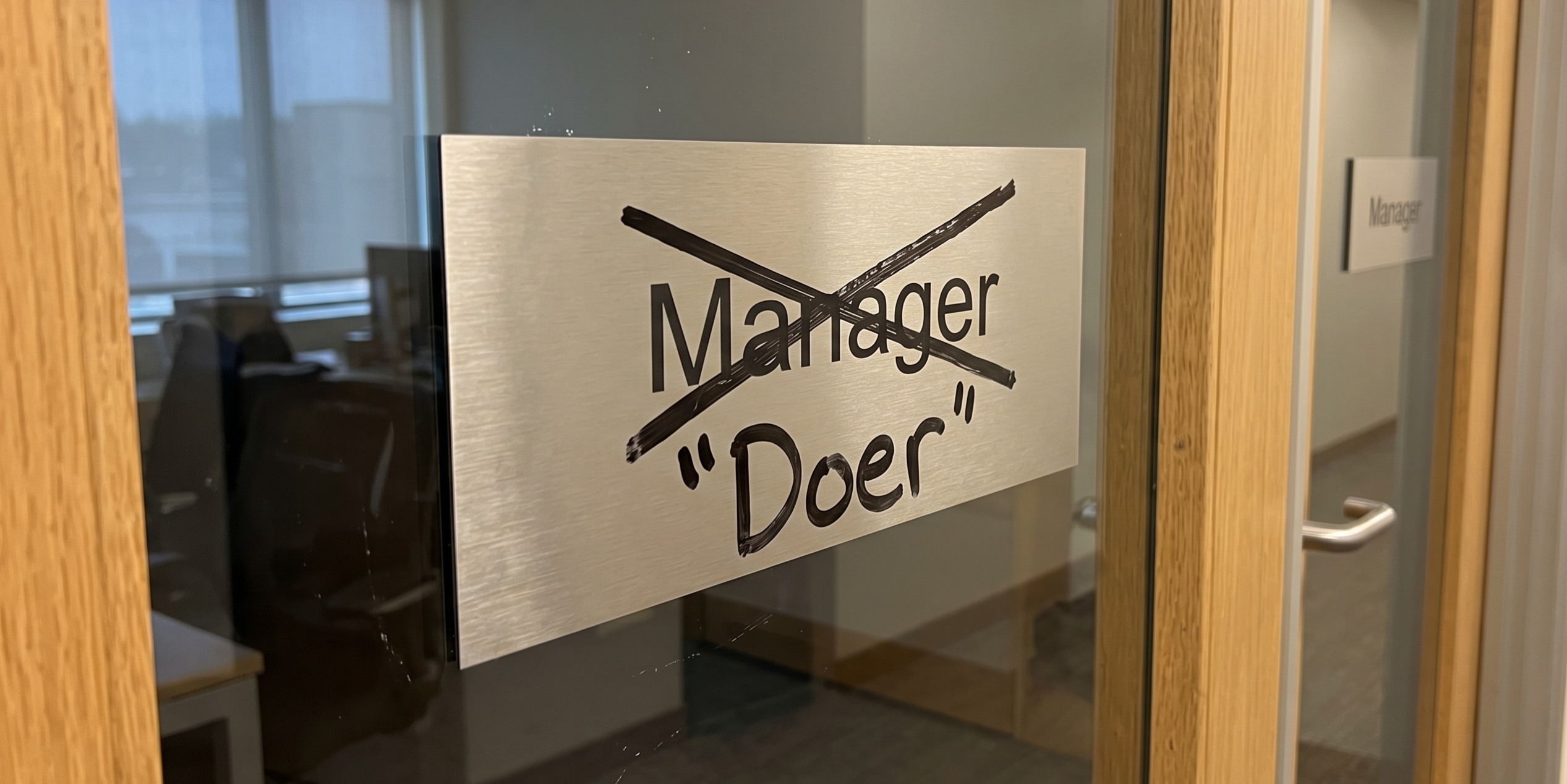
The new job architecture that's emerging looks something like this: everyone is a doer first. Management duties, the performance tracking, the task coordination, the resource allocation, those become secondary functions that you offload to a swarm of AI agents and supervise rather than execute. You're a builder who also oversees. You're an engineer who also mentors. You're a designer who also allocates. The 'pure manager' job title, the one where your calendar is all 1:1s and your deliverable is a status deck, that's the one that's disappearing.
And beneath that, the enterprise is splitting into 2 functional groups. Builders: the people who design systems, write code, create AI workflows, architect the operational backbone. Consumers: the people who use those systems to execute business objectives. If your role doesn't clearly fit in either group, you need to figure out which one you're moving toward, because the space between them is closing.
Stale hierarchies and rigid job titles can't survive this environment. The org charts that most Fortune 500 companies are running today were designed for a world where information moved through people. Information moves through agents now. The people layer that existed to route it is redundant.
The career divide
There's a bifurcation happening in careers right now that I don't think enough people are talking about honestly.
On one side are the early adopters. These are people who saw agentic AI coming, learned the tools, and started building before their companies officially sanctioned it. Some of them are engineers. A lot of them aren't. They're analysts who taught themselves to build RAG pipelines. Product managers who learned prompt engineering and started automating their own reporting. Operations people who connected an AI agent to their CRM and cut 3 days of weekly manual work down to 20 minutes.
For these people, this transition is a massive career unlock. They're getting pulled into new AI-focused roles. They're being asked to train others. They're becoming the de facto architects of how their teams operate. The demand for people who can bridge business knowledge and AI tool proficiency is growing faster than the supply, and the ones who got there early are being rewarded disproportionately.
On the other side are the people I'll politely call the legacy operators. They've built careers on a specific software stack, a specific process, a specific domain of expertise that was valuable because it was hard to learn and slow to change. Enterprise resource planning specialists. People who spent years mastering a particular BI tool. Managers who built influence through gatekeeping access to information and stakeholders.
These people are watching their moats drain. The information they used to control is now surfaced by agents in seconds. The software expertise they built over a decade is being replicated by someone with Claude and a weekend. The process knowledge they accumulated is being codified into automated workflows that don't need a human intermediary.
And their response, overwhelmingly, is to freeze. FOBO. Fear of becoming obsolete. It's different from the fear of getting fired. It's the fear that your fundamental value proposition as a professional is evaporating and you don't know how to rebuild it. Studies from early 2026 show that a majority of workers harbor concerns about AI making their roles obsolete, and the behavioral consequences are measurable. Lower engagement. Resistance to adopting AI tools. Reluctance to experiment because experimentation might confirm that the tool actually can replace what they do.
I get it. The anxiety is rational. But the freeze is career suicide. The gap between the early adopters and the late adopters is already wide, and it compounds daily because the early adopters are learning faster, getting better tools, and building the systems that the late adopters will eventually have to use or be replaced by.
The old corporate moats, knowing the right people, understanding the legacy system, being the only one who can run the monthly close process, those are dry. AI doesn't care about your institutional knowledge. It cares about data, APIs, and clear objectives. If your value depended on being the only person who knew how something worked, you're in trouble, because that knowledge is no longer locked in your head. It's in a system that anyone can query.
The playbook for CHROs and CIOs
If you're leading a workforce through this transition, and you should be, because your board is going to start asking about it if they haven't already, here's what I'd suggest based on what I've seen work and what I've seen fail.
Stop telling people their jobs are safe. You don't know that, and they can tell you don't know that. False reassurance destroys trust faster than hard truth. When Gale's memo at Meta said 'your teams have been redesigned using AI-native principles,' that was honest. It was unsettling, but it was honest. People can work with honest. They can't work with 'nothing's changing, we're just adding some AI tools to help you out' when they can see entire departments getting restructured around them.
Be brutally transparent about the fact that job titles, job descriptions, and job architectures are going to change fundamentally. Not 'might change.' Will change. The question isn't whether, it's how fast and in what direction. Tell people that upfront and they can start preparing. Shield them from it and you lose 12 months of adaptation time that you can't get back.
Show people how to pivot their mindset. Most employees have spent their entire careers being told what to do. They were hired for a job with a description, given tasks within that description, and evaluated on how well they performed them. That model assumed the work was stable. The work is not stable anymore.
The new model requires people to ask a fundamentally different question: what am I actually good at beyond my job title? Not what does my role description say. Not what do I get assigned. What can I do that creates value, that I'm genuinely skilled at, that compounds over time? Maybe it's explaining technical concepts to non-technical stakeholders. Maybe it's pattern recognition across messy data. Maybe it's the ability to hold context across a dozen concurrent projects and spot the connections nobody else sees.
Whatever it is, that's what you build on. The job title is a label that will change. The underlying capability is the thing that transfers across whatever the org chart looks like in 18 months.
Encourage experimentation, but make it structured. The worst version of AI adoption is what I wrote about in my vibe coding piece: hand out tools with no guardrails and let people build random things nobody needs. The best version is directed experimentation where teams are given specific business problems, AI tools, and the freedom to figure out solutions, with someone who actually understands the technology providing guardrails and review.
And finally, make builders out of as many people as you can. The builder-consumer split I described isn't a natural law. It's a skill distribution that leadership can influence. Every person you move from consumer to builder is a person who becomes more valuable to the organization, harder to replace, and more engaged because they're creating rather than just executing. The training investment for that is real but the ROI compounds in ways that traditional L&D programs never did, because the tools are so powerful that even modest technical fluency translates into disproportionate output gains.
The middle management extinction event is happening. Meta just showed us what it looks like when a company with 79,000 employees decides the management layer was designed for a pre-AI operating model and starts removing it deliberately. Your company's version of this is coming. The timeline depends on your industry, your board, and your competitive pressure. But the direction is set.
The question for every CHRO and CIO is whether you're going to design the transition or get reorganized by it.
---
Sources:
- Meta layoffs (8,000 cuts, 7,000 reassignments, 6,000 roles eliminated, May 2026): Benzinga, IndiaToday, PeopleMatters
- Janelle Gale internal memo on AI-native design principles: EconomicTimes, PeopleMatters
- Meta AI-focused units (Applied AI Engineering, Agent Transformation Accelerator, Central Analytics): Benzinga, IndiaToday
- Meta's shift to pods/cohorts organizational model: HRKatha, LeadDev
- AI agent capabilities in performance management (Lattice, 15Five, Leapsome): industry reporting
- Manager-to-employee ratios at Meta AI units (1:50): internal reports, The Information
- FOBO (fear of becoming obsolete) research and workforce studies: Morningstar, WTW, PeopleManagingPeople
- Builders-consumers enterprise bifurcation: Forbes, Fast Company, Deloitte
- CS enrollment drop (8%): previous reporting, American Economic Journal
- Glassdoor tech confidence all-time low: Glassdoor
- Goldman Sachs AI displacement projections (0.5-2.4 pp unemployment): Goldman Sachs Research
Comments (0)
No comments yet. Be the first to share your thoughts!